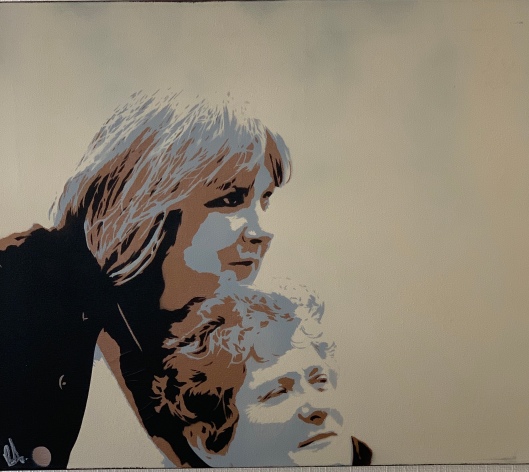
You make me brave.
You make me strong.
You make me fearless.
You make me believe that anything’s possible.
That there is nothing I cannot do,
I will accomplish the unimaginable.
Conquer the world.
And all this since the moment
You vanquished me….
It is my darling heart’s birthday today, and this is one of my birthday presents to her….Happy Birthday my darling, the truly wonderful Anita-Clare Field!
My past’s contained in sound bites,
Wed, yet not a pigeon pair,
Fights and sleights, yet few insights,
It felt like solitaire.
Then you walked into my life,
A wounded creature too,
You too’d felt heartache, torture, strife,
Felt the world askew.
I think we saved each other,
From feeling lost and sad,
And scared and kind of smothered,
In a place gone bad and mad.
And now, each time I see your face,
It’s like the world’s been forged anew,
And all my happiness and grace,
Is bound firmly up in you.
I feel like we share everything,
Goals and views and schemes,
I feel my future’s on the wing,
We’ll achieve our hopes and dreams.
No longer feeling I’m alone,
Walking a solitary path,
Everywhere WE are is home,
YOU, its heart, its hearth.
The extraordinary Jemima Layzell wanted to be an author. She is now, but sadly posthumously. She died, unexpectedly, from a brain haemorrhage last year. However, at the age of 13 she decided she wanted to be an organ donor. She saved the lives of eight people and transformed the lives of two more. I urge you to buy her book. It has been endorsed by two children’s laureates, Dame Jacqueline Wilson and Michael Morpurgo. Her book is published today and available via Amazon. Today would have been her birthday. Our thoughts are with Harvey, Sophy and Amelia, who survive her. Please share this, it needs to reach as many people as possible.
Today I am honouring Jemima Layzell,
She wanted to write and she does it well.
She’s prodigiously gifted, as you will see,
If you buy her extraordinarily prescient diary.
Just before she died she told her dad,
That if she did, it would make her glad,
To donate her organs to keep others alive,
That her death would permit others to survive..
A mature approach, and very bold,
Astonishing for one only 13 years old.
Her parents made this fervent wish arrive,
Thanks to them and her, 10 people now thrive.
And now they’ve fulfilled her second dream,
To be a part of academe.
So gentle reader, buy her book,
I assure you it is definitely worth a look.
Ann Mullen asked me to write more about where coffee comes from and how the flavours differ…so here we go! I have slightly rewritten this post for my darling as a guest blog for her Meat Free Monday on Lover of Creating flavours today.
Around about 600 AD, legend has it that a young Ethiopian goatherd by the name of Kaldi saw his goats feeding off particular shrubs which, upon eating their reddish-brown berries, seemed to energize them. He too tried the ‘berries’, as did some monks who observed him, and so the buzz that coffee gives us was discovered. Not surprising, given the fact that the Yirgacheffe region is known for its intensely dark, fruity coffee and the country is renowned for its espresso coffees in particular.
By 1000 AD, the Arabians were roasting and brewing the bean and by the 13th century, the Muslim nations were regular coffee drinkers. In those days, Muslims were trading in Africa, the Mediterranean and India, so its popularity gradually spread around the world. However, the Arabian traders boiled their beans before selling them, ensuring this would make them infertile and so the cultivation of the bean would remain confined to Arabia and Africa.
This monopoly was finally broken when an Indian pilgrim to Mecca, Baba Budan, smuggled some beans out of the country and by 1616 the Dutch had established the drink throughout Europe and by 1696, had set up the first coffee estate in Java. The Dutch, to this day, are leaders in coffee production. In 1792, Lt. Col. Francisco de Melo Paleta smuggled the bean to Brazil and although it started out as a drink for the elite, it very quickly became a favourite with the entire populace, and so the long and noble tradition of coffee cultivation there began.
So let’s start with Brazil, which is the largest coffee bean producer in the world. Ironically, its tiniest island, Réunion, formerly known as Bourbon, produces a cultivar of particularly aromatic beans, that are dark, with a delicate balance of acids. Other great coffee from this part of the world is the bean from Colombia, which has a much lighter, sweeter flavour, the one from Panama, that has a much fruitier overtone and Nicaraguan coffee which is powerful and full bodied.
Move further north to Cuba, where the coffee is as punchy as the cigars; it is seriously strong with a kick like a mule. Jamaica, my homeland, produces one of my favourites, the mellow nectar that is Blue Mountain coffee and Hawaii cultivates a bean that is very full-flavoured yet simultaneously smooth.
Travel round the world to Indonesia and Malaysia for the famous Javan – so famous that a java is American slang for a coffee. The Sumatran is not as harsh as the Javan, having a thicker, sweeter, gentler flavour. Move on to India, where it seems that Indian coffee appeals to the European palate because its reputation for producing a fruiter, sweeter, less acidic coffee was ratified at the Grand Cus de Café contest in Paris in 2004, where an Indian coffee won 3 gold medals. Then travel west to Yemen which produces some of the most famous mocha coffee in the world. Mocha is actually a port on the Red Sea in Yemen, which is famous for its coffee beans. The word mocha is now synonymous with the coffee beans which have an intense chocolate overtone.
Some won’t forgive me for not including El Salvador, which produces a coffee bean that is chocolately, nutty and has a hint of caramel, or Papua New Guinea, also nutty and chocolatey, or Costa Rica, whose beans produce a fruity coffee with a creamy finish. You will all have your personal favourites, this post is just a small illustration of the fact that coffee, just like wine, differs radically according to its provenance. I just urge you to broaden your horizons, educate your palates and see how wonderfully diverse the world of coffee truly is….
Delicate as a mayfly’s wing,
The French adore their fleur de lys,
‘Cause they make a gorgeous centrepiece,
I particularly like the purple one,
With a splash of yellow, like the sun,
It’s nature in a grand design,
It’s regal, yes, it’s palatine,
So make me happy, make me smile,
Give me this flower of grace and style.
It makes me slightly mad,
That they are used at funerals,
At moments that are sad.
Particularly, my favourite one,
Pure and just off white,
Its fragrance fills the room it’s in,
A source of great delight.
I’ve made a promise to my darling,
That when I have moved in,
I’ll buy a bouquet every week,
So let the fun begin!
I hear just one bar of this beautiful beat,
And the rhythm invades my soul and my feet.
My hips start swaying, and then my tush,
I want to grind and I want to push.
This music does a real good job
Of making my heart start to pulse and throb.
I swear that it’s alive, infectious,
It hits you in the solar plexus.
It’s a breath of home, it’s from my roots,
It lifts me then shimmies me down to my boots.
Hear one note and my feet start to move,
I’m in the zone, I’m in the groove.
Just like Mr Lloyd Webber’s cello,
It’s powerful yet it’s very mellow.
Ska or reggae, it’s my choice
Of music to which I can rejoice.